Introduction of the Regulatory Standards Bill

What is the Regulatory Standards Bill ?

This purpose of the Bill is stated as “to improve the quality of laws in New Zealand by making the law making process more transparent and accountable.  It aims to reduce poor or unnecessary rules and ensure laws respect key principles like fairness, personal freedoms, and proper use of taxes.”

The Bill provides a platform for Parliament to check laws more closely and keep better control over powers given to government agencies.  It requires Ministers and agencies to check if new and existing laws follow these principles and to publicly explain any issues.

Public Consultation for the Regulatory Standards Bill

Initial public consultation on the proposed Regulatory Standards Bill ran from 19 November 2024 to 13 January 2025.  During this period, the Ministry for Regulation received around 23,000 submissions, with approximately 88% opposing it.

Key concerns included the Bill’s necessity, potential overlap with existing regulatory tools and risks to Māori rights and Te Tiriti o Waitangi as well as potential negative impacts on social, environmental, and economic outcomes.  The consultation process itself was also criticised for its short timeframe, lack of proper engagement with Māori, and limited transparency.

The Tribunal Inquiry

In response to the concerns over the proposed Regulatory Standards Bill which were brought to the Waitangi Tribunal, the Tribunal held an urgent inquiry into the Regulatory Standards Bill.  The Tribunal heard claimant and Crown submissions on 14 May 2025 and released an interim report on 16 May 2025.

The Waitangi Tribunal found that:

· The Crown breached the Treaty principles of partnership and active protection by failing to meaningfully consult with Māori before Cabinet took significant decisions as to the content of the proposed Regulatory Standards Bill on 5 May 2025.

· Introducing the Bill to Parliament and proceeding to enact the act without meangingful consultation with Māori would further breach treaty principles of partnership and active protection.

· The Bill could affect a wide range of Māori rights, not just those addressed in settlement or redress legislation. It expressed concern about the Bill’s sub-principle that “every person is equal before the law,” which could be used to challenge laws designed to achieve equity for Māori.

· The Crown has a duty, shaped by New Zealand’s colonial history, to actively seek fair and equitable outcomes for Māori through inclusive and informed legislative processes.

The panel found that two core strains of prejudice arise, or will arise from the findings above to Māori, these being:

· Damage to the Crown and Māori relationship due to the Crown’s action in progressing the policy without engaging with Māori adequately and;

· Emotional distress and uncertainty arising from the unclear impacts of the Bill, due to the Crown’s failure to engage meaningfully with Māori.

Recommendations

The Tribunal recommended that the Crown pause progress on the Bill and initiate genuine consultation with Māori on both the Bill’s necessity and its possible consequences.  Despite this recommendation, the Government introduced the Bill on 18 May and passed its first reading on 22 May.  This has led to further concern about the Crown’s commitment to working in partnership with Māori.

While the Regulatory Standards Bill aims to improve how laws are made in New Zealand, it has raised major concerns regarding its impact on Māori rights and Te Tiriti o Waitangi.  Public consultation showed strong opposition, and the Waitangi Tribunal found that moving forward without proper Māori engagement would further breach Treaty principles.

Public submissions to the Select Committee are open until 23 June 2025.


Carmen Mataira is a Senior Solicitor in our Kahurangi Tiriti team and can be contacted on 07 958 7444.

Indirect Data Collection – What do you need to know about the Privacy Amendment Bill?

Information privacy principles (or “IPPs”) under the Privacy Act 2020 apply to any public or private agency collecting personal information in New Zealand, including companies and individuals. These principles currently include that information must be collected for a lawful purpose, and protected by reasonable security safeguards. However a new principle, referred to as IPP3A, will create an additional obligation on companies collecting information indirectly i.e. from sources other than the individual concerned.

Direct vs Indirect Collection

Current principles IPP2 and IPP3 require that information must be collected directly from the individual concerned, except in certain specific scenarios. As part of this direct collection, the agency must take steps to ensure that the individual is aware that their information is being collected, its purpose, and its intended recipients.

One of the exceptions to direct collection is where the individual has authorised the collection of the information from another source, for example through external agencies providing credit or background checks, or third-party data brokers selling customer data.  Currently, the Act does not require the individual to be notified of that indirect collection.

New IPP3A

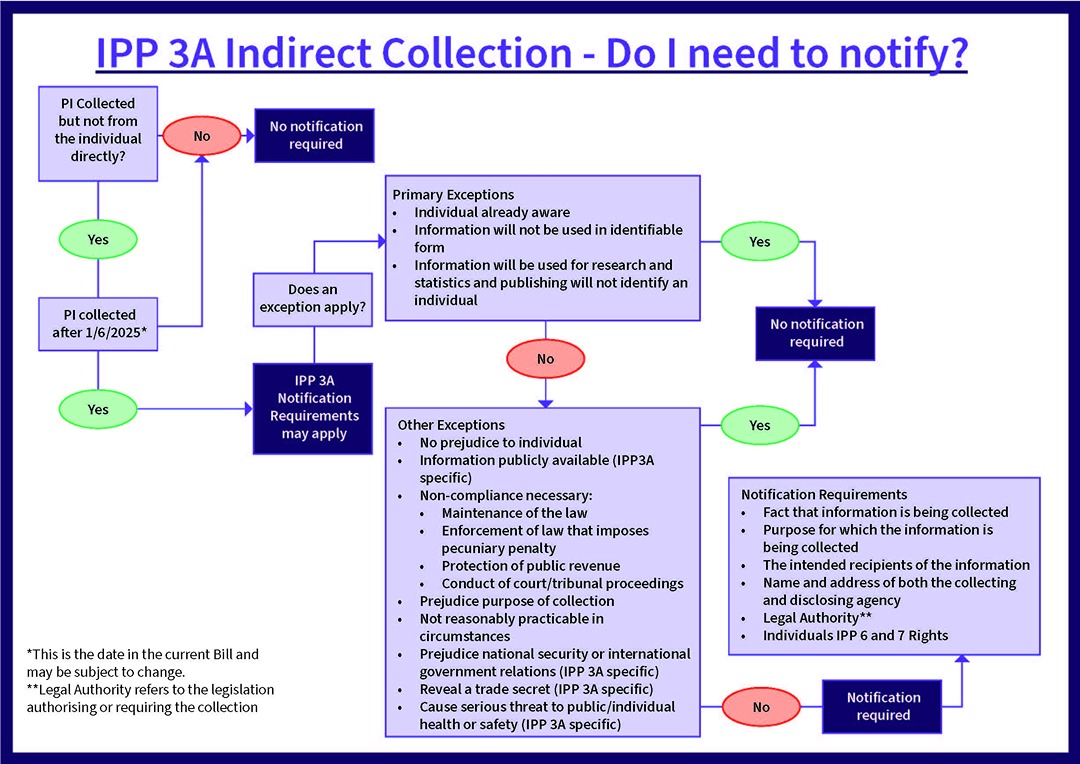
IPP3A is set to come into force in May 2026, introducing a new requirement on agencies to ensure that individuals are aware of the fact that information has been collected, even where that collection happens indirectly.

Under IPP3A the agency must take steps that are reasonable “in the circumstances” to ensure that even when it collects information about an individual indirectly, the individual is aware of:

  • The fact that information has been collected;
  • The purpose for which information was collected;
  • The intended recipients of that information;
  • The details of the agencies that collected the information, and that hold the information;
  • Any particular law authorising the collection of the information; and
  • The individual’s rights of access and correction of the information.

These steps must be taken ideally before the information is collected, or as soon as practicable afterwards.

Exceptions

There are some specific exceptions to this requirement, including where:

  • Compliance is not reasonably practicable in the circumstances;
  • Non-compliance would not prejudice the individual’s interests;
  • Compliance with the requirements would prejudice the purposes of the collection; or
  • Informing the individual concerned would cause a serious threat to public health or safety, or to the health or safety of another individual.

How to prepare

It is critical that you are aware of all information collections undertaken by your business whether directly or indirectly, from sales and marketing through to IT and human resources, and have considered your obligations from a privacy perspective. The Privacy Commission publishes a template collections register, in which you can record the information collections that your business undertakes, and work through the applicable requirements for each. The Commission also publishes a handy flowchart to take you through information collection step-by-step and identify your obligations.

The new information privacy principle comes into effect on 1 May 2026, so you have time to consider what systems you need to introduce or improve to ensure compliance. The Commission intends to publish additional guidance on the new principle and how organisations can best prepare, so watch this space. In the meantime, please talk to your lawyer about whether these changes will impact your business.


Jessica is a Senior Associate in our Commercial Team and can be contacted on 07 958 7436.

Contact us

HAMILTON OFFICE

P. 07 838 2079

E. reception@mccawlewis.co.nz

Level 6, 586 Victoria Street
Hamilton 3204
New Zealand

TE KŪITI OFFICE

P. 07 878 8036

E. reception@mccawlewis.co.nz

36 Taupiri Street
Te Kūiti 3910
New Zealand