Indirect Data Collection – What do you need to know about the Privacy Amendment Bill?

Information privacy principles (or “IPPs”) under the Privacy Act 2020 apply to any public or private agency collecting personal information in New Zealand, including companies and individuals. These principles currently include that information must be collected for a lawful purpose, and protected by reasonable security safeguards. However a new principle, referred to as IPP3A, will create an additional obligation on companies collecting information indirectly i.e. from sources other than the individual concerned.

Direct vs Indirect Collection

Current principles IPP2 and IPP3 require that information must be collected directly from the individual concerned, except in certain specific scenarios. As part of this direct collection, the agency must take steps to ensure that the individual is aware that their information is being collected, its purpose, and its intended recipients.

One of the exceptions to direct collection is where the individual has authorised the collection of the information from another source, for example through external agencies providing credit or background checks, or third-party data brokers selling customer data.  Currently, the Act does not require the individual to be notified of that indirect collection.

New IPP3A

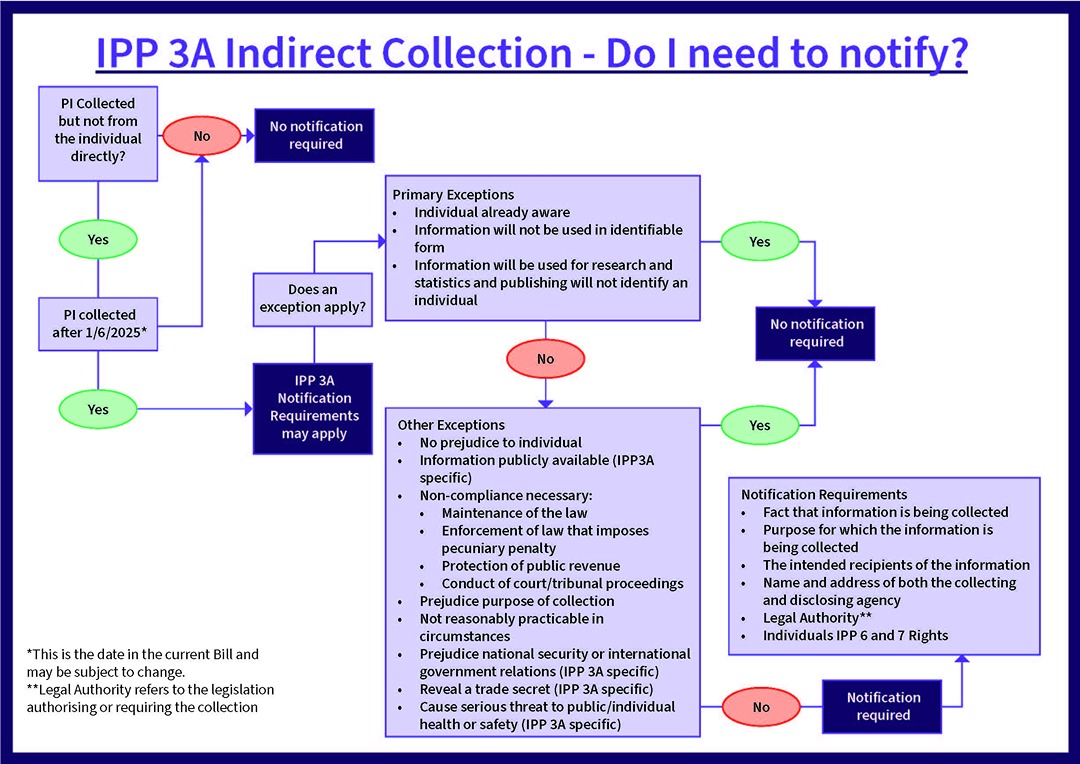
IPP3A is set to come into force in May 2026, introducing a new requirement on agencies to ensure that individuals are aware of the fact that information has been collected, even where that collection happens indirectly.

Under IPP3A the agency must take steps that are reasonable “in the circumstances” to ensure that even when it collects information about an individual indirectly, the individual is aware of:

  • The fact that information has been collected;
  • The purpose for which information was collected;
  • The intended recipients of that information;
  • The details of the agencies that collected the information, and that hold the information;
  • Any particular law authorising the collection of the information; and
  • The individual’s rights of access and correction of the information.

These steps must be taken ideally before the information is collected, or as soon as practicable afterwards.

Exceptions

There are some specific exceptions to this requirement, including where:

  • Compliance is not reasonably practicable in the circumstances;
  • Non-compliance would not prejudice the individual’s interests;
  • Compliance with the requirements would prejudice the purposes of the collection; or
  • Informing the individual concerned would cause a serious threat to public health or safety, or to the health or safety of another individual.

How to prepare

It is critical that you are aware of all information collections undertaken by your business whether directly or indirectly, from sales and marketing through to IT and human resources, and have considered your obligations from a privacy perspective. The Privacy Commission publishes a template collections register, in which you can record the information collections that your business undertakes, and work through the applicable requirements for each. The Commission also publishes a handy flowchart to take you through information collection step-by-step and identify your obligations.

The new information privacy principle comes into effect on 1 May 2026, so you have time to consider what systems you need to introduce or improve to ensure compliance. The Commission intends to publish additional guidance on the new principle and how organisations can best prepare, so watch this space. In the meantime, please talk to your lawyer about whether these changes will impact your business.


Jessica is a Senior Associate in our Commercial Team and can be contacted on 07 958 7436.

Directors’ Duties in Tough Economic Times: What You Need to Know

Directors of companies in New Zealand are facing ever more challenging economic conditions characterised by varying interest rates, inflation, and market volatility.  During periods of financial stress, directors must navigate complex legal responsibilities carefully, as failure to comply with statutory duties can lead to severe consequences, including personal liability and regulatory penalties.

Here’s a quick look at the key directors’ duties under the Companies Act 1993 (the Act) and some practical advice on how directors can mitigate risks during these trying times.


Core Duties of Directors

Under the Act, directors are bound by several fundamental obligations.  Firstly, directors must always act in good faith and in the best interests of the company.  In tough economic conditions, acting in the company’s best interests might involve making difficult but necessary decisions such as restructuring, cost reductions, or pursuing external investment.

Directors also have a duty to exercise the level of care, diligence, and skill that would be expected of a reasonable director in similar circumstances.  Practically, this means staying informed about the company’s financial health and being actively involved in its decision making.  The directors’ vigilance is particularly key in avoiding reckless trading, as continuing business operations in a manner that risks substantial loss to creditors is prohibited.

Further obligations arise when the company is approaching insolvency.  Directors must avoid incurring new obligations if there is a reasonable belief that the company may not meet these liabilities.


Key Risks for Directors in Financially Stressed Businesses

Economic downturns introduce heightened risks for directors, particularly around cash flow management and creditor relationships.  Ensuring that the company maintains its ability to meet payment obligations is essential, as failure to do so can expose directors to potential legal actions from creditors.  Additionally, insolvent trading, which is continuing operations while unable to meet financial commitments, can lead to personal liability for directors.

In such conditions, directors are often subject to increased scrutiny from stakeholders, including shareholders, creditors, and regulatory authorities. Creditors may seek to call in debts owing, and shareholders have rights of action under the Act against the company and directors personally, as well as potentially the right to bring actions against directors on behalf of the company. Regulatory authorities can impose fines and, in a worst case scenario, criminal sentences.

Directors’ actions must demonstrate transparency, responsible governance, and compliance with all legal obligations to minimise potential claims or regulatory intervention.


Practical Guidance for Directors

To safeguard themselves and their companies, directors should take several proactive measures. Regular financial monitoring is key here, with close attention paid to cash flow, profit margins, and the company’s liabilities.  Financial performance should be reviewed at a Board level regularly and rigorously.

To navigate complex situations and to minimise personal risk, directors should seek professional legal and financial advice early and often.

Transparent and honest communication with stakeholders is equally important, as proactive dialogue can help quell any uncertainty and avoid disputes or shareholder action.

Directors should also be open to exploring restructuring options, such as voluntary administration, creditor compromises, or, where necessary, winding up the company.


Recent Case Highlight

A recent and significant case highlighting the importance of directors’ duties is Yan v Mainzeal Property and Construction Limited [2023] NZSC 113.  Mainzeal was placed into liquidation in 2013, owing unsecured creditors approximately $110 million.  The Supreme Court found that the directors breached sections 135 (reckless trading) and 136 (duties in relation to obligations) of the Act.  The directors had improperly relied on informal assurances of financial support without enforceable guarantees.  The directors were ordered to personally pay $39.8 million (plus interest).  This decision highlights the necessity for directors to rigorously adhere to statutory obligations, particularly around solvency and creditor protection, at the risk of their own personal liability.


Final Thoughts

Tough economic conditions demand directors demonstrate cautious, informed leadership and strict compliance with the statutory duties outlined in the Act.  By understanding these obligations and proactively managing financial risks, directors can effectively navigate periods of economic uncertainty. Seeking timely professional advice is essential to mitigate potential liabilities and ensure informed decision making that protects both the company and its directors.

If you are a director experiencing financial challenges, consulting with your legal and financial advisers can provide essential guidance on fulfilling your obligations and safeguarding your business.

Selling your Business: The Seven Things You Need to Do First

There are many reasons you could be looking to sell your business in 2024.  Maybe you want to free up some capital to pursue other ventures.  Maybe you are retiring.  Maybe the last few years have simply made you realise you want to do other things.

Whatever your reason, getting your business ready for sale is an important step to ensure you maximise the purchase price you may receive, and enable a smooth transition to the new owner with minimal stress to your employees – and yourself.

With that, here are our top ten tips for preparing to sell your business:

1. Get your House in Order

Do you have up-to-date accounts and other financial information?  Is your lease documentation current and complete?  Do you have a solid business plan in place?  Are there any problems with employees that need to be addressed?  Are your assets in good working order?   Is all registrable intellectual property validly registered?  Do you have binding contracts in place with key suppliers and customers?  These are all questions you need to start asking yourself to ensure your business is in a good condition for sale.

2. Talk to your Advisors

We’re not just talking about your trusted legal advisor.  Usually before you start discussions with your legal team, you should have worked through the prospects of a sale and potential financial and tax implications with your accountant.   You will also want to discuss the sale with your business banker.  Finally, you may wish to consider engaging a business broker, who can help you to set a price and negotiate with potential buyers.  We have some great contacts in these areas who we can highly recommend if needed.

3. Shares or Assets?

There are two ways you can sell your business.  You can sell the assets of your business as a going concern (this includes the business name and any business premises lease), or you can sell the entity that owns your business assets – e.g. the shares in your company.  There are potential benefits and risks involved in each option, and it’s important you talk to your advisors early to determine what is best for you.

4. Protect Yourself

You’re about to hand over a lot of your confidential information to a third party to enable them to assess whether or not they want to purchase, and at what price.  Make sure you have a robust Confidentiality Agreement/Non-Disclosure Agreement in place to ensure your valuable information doesn’t end up in the wrong hands.

5. Package It Up

Consider preparing an information pack – sometimes called an Information Memorandum – which gives potential purchasers the data and information they will need to make an informed decision as to whether or not to purchase your business.  The pack will potentially include financial information from the last few years, a copy of your lease, business history and information on the business assets.  Just make sure your confidential information is protected (see step 5).

6. Stay Positive

These things take time.  You may not have the flurry of activity you anticipated in the first few weeks, but stick with it and try to refrain from selling in a rush, which may mean you accept a purchase price that is lower than what your business is actually worth.

7. Come See Us

You have an offer on the table – great news!  We would always recommend getting your solicitor to look over the Agreement for Sale and Purchase before signing.  If that is not possible – you’re under pressure to sign or are just super excited – it would be worth including a condition in the Agreement for solicitor’s approval.  This gives us a chance to look over the Agreement after it is signed and make any changes necessary to protect you.  Rest assured, we’re not out to make changes just for the sake of it.

What next?

Just because an Agreement for Sale and Purchase has been signed, that doesn’t mean it’s time for rest.  We will outline the sale process in another article.

We are happy to discuss anything in this article that may have captured your attention.  Feel free to get in touch.

New Guidelines on Trade Marks Containing Māori Elements

Overview

The updated guidelines focus on ensuring that any use of Māori words, symbols or other cultural elements in trade marks is done with respect and understanding.  Key to this process is the role of the Māori Advisory Committee, which has been given an enhanced role in assessing trade mark applications that involve Māori elements.  The role of the Māori Advisory Committee is to advise on whether a trade mark is likely to be offensive to Māori, or if it constitutes a misappropriation of traditional knowledge or cultural expressions.

The guidelines make it clear that the inclusion of Māori elements in a trade mark is not merely a branding decision but a cultural consideration that requires careful thought and consultation.  An evaluation by the Māori Advisory Committee can significantly impact the outcome of a trade mark application either bolstering or reducing the chances that an application is approved.  Making it essential for businesses to be well-prepared when submitting applications that include Māori elements.

Business Considerations

Cultural Appropriateness and Sensitivity

The guidelines encourage businesses to consider the potential impact of their trade marks on Māori communities and to take steps to ensure that their use of Māori elements is respectful and culturally appropriate.   This requires a deep understanding of the cultural significance of the Māori elements being used and a careful assessment of whether their use might be perceived as offensive or disrespectful.  Businesses need to approach the use of Māori elements with a genuine respect for Māori culture and avoid any forms of cultural appropriation that might exploit or misrepresent Māori heritage.

Engagement with Māori Communities

The primary recommendation of the guidelines is that businesses engage with relevant Māori communities when developing trade marks that include Māori elements.  This engagement is not only a way to ensure that the trade marks are culturally appropriate but also a demonstration of the business’s commitment to upholding the principles of Te Tiriti o Waitangi.  Engaging with Māori communities can involve consulting with iwi or hapū, discussing with Māori artists or engaging cultural experts. The type of activity and who to consult depends on the specific cultural elements involved in the trade mark.  These consultations can provide valuable insights and help build trust and positive relationships with Māori communities.  By obtaining the support or endorsement of Māori communities for the use of certain cultural elements, an applicant can strengthen its trade mark application and reduce the risk of objections by the Māori Advisory Committee during the registration process.

Navigating the Guidelines

Before applying for a trade mark, businesses should conduct a comprehensive cultural audit of the Māori elements they intend to use.  This will involve evaluating the cultural significance of the elements and ensuring that their use aligns with Māori values and traditions.  Seeking advice from experts in Māori culture or intellectual property law is crucial and is emphasised repeatedly throughout the guidance.  Early and meaningful engagement with Māori communities can help identify potential cultural concerns and build a foundation of mutual respect and understanding.  This engagement should be approached with sincerity and a willingness to listen to the perspectives of Māori community members.

Final Thoughts

The updated guidelines on trade marks containing Māori elements represent a next step in recognising and respecting Māori culture within Aotearoa, and more specifically within the realm of intellectual property which can extend globally.  By adhering to these guidelines and engaging in respectful consultation with Māori communities, businesses can ensure that their trade mark applications are both legally compliant and culturally appropriate.  These guidelines not only seek to help protect the cultural heritage of Māori but also offer businesses an opportunity to contribute positively to the broader recognition and preservation of Māori culture.

For more detailed information, the official guidance on the updated guidelines can be found on the Ministry of Business and Innovation and Employment website together with the Intellectual Property Office NZ guidelines.

If you need assistance with navigating these new guidelines, our Commercial and Kahurangi Teams are well-equipped to assist you to ensure your trade mark application is both compliant and culturally appropriate.

Ezrom Waka is a Solicitor in our Commercial Team and can be contacted on 07 959 2313.

Important Updates in the World of Business

The Government is taking further steps to modernise the (somewhat archaic) Companies Act 1993 (the Act), with Hon Andrew Bayly, Minister of Commerce and Consumer Affairs, recently announcing the Government’s backing for a comprehensive reform package.

The broad purpose of these reforms is to simplify business in New Zealand, including by reducing business compliance costs – all of which is good news and potentially long overdue.

The reforms are set to roll out in two phases starting in 2025:

  • Phase 1: The focus here will be on updating and modernising the Act, simplifying compliance for businesses, and strengthening measures to prevent unethical and illegal business practices.
  • Phase 2: This second phase will involve the Law Commission reviewing the directors’ duties set out in the Act, giving particular attention directors’ liability, sanctions, and enforcement.  Some of this review has come off the back of the Mainzeal case – see our article on that here.

What Will Happen in Phase 1?

Time to bring the Act into the 21st century

The Act is some 30 years old, and is still a key piece of legislation for businesses operating in New Zealand.  Time has obviously moved on, and the amendments to the Act seek to bring it into the present, by:

  • simplifying the process for share capital reduction, reducing the need for expensive and time-consuming court approvals;
  • similarly, enabling more broad use of unanimous shareholder consent processes (e.g. for share issues or conversions, and the company acquiring its own shares to be held as treasury stock);
  • updating the definition of “major transaction” to exclude those transactions that solely a company’s capital structure (e.g. share issues, buy-backs, declaring dividends and redeeming shares), but also to provide that a series of transactions that are related to each other can also be caught by the definition;
  • enabling certain company documents to be accessed online rather than manually; and
  • introducing procedures for managing unclaimed dividends where a shareholder cannot be contacted.

Know who you’re dealing with

One of the key aims of the reforms is to strengthen the processes for identifying and preventing unethical/illegal business practices; this involves being able to more easily identify persons in control, while still protecting their privacy.  This will include:

  • introducing unique identifiers for directors and general partners of limited partnerships; and
  • allowing directors to use services addresses in the company’s public records, rather than their private residential addresses.

Protection for creditors if it all goes wrong

These proposed amendments will seek to incorporate the recommendations of the Insolvency Working Group set up in 2015, and importantly will extend the “claw back period”, within which related party transactions undertaken prior to liquidation can be voided, to four years.

NZBN? What’s that?

Most of us are familiar with the concept of an NZBN, but more commonly use the more traditional Companies Office number when referring to companies.  The proposed amendment would seek to increase the use of the NZBN, potentially improving business efficacy and identification.

What next?

All going well, the bill to introduce Phase One will be introduced in 2025 at which stage submissions will be open to the public.

But I’m not happy with this?

If you are keen to find out more, including what you need to do to make a submission, please get in touch.

A tenant’s snapshot guide to commercial leasing

Commercial leases are a core component of most businesses operating in New Zealand, and as a tenant it is essential to understand the key terms, and potential risks associated with your lease agreements, to ensure that your commercial endeavours can thrive.

Below, we will briefly discuss some of the key elements of which to be aware and advise on how to avoid some of the more common pitfalls.

Understanding the Legal Framework

Commercial leases in New Zealand are governed by the Property Law Act 2007 (the Act).  The Act outlines baseline requirements and rights of landlords and tenants, however many of the lease terms can be set or changed based on what works for the parties’ specific circumstances. It is up to you to ensure that your lease is fit-for-purpose and makes sense for your business.

Negotiation of Lease Terms

Commercial lease negotiations can involve a wide range of terms including rental amounts, term, renewal options and rent reviews as well as any special conditions specific to the parties or premises.

We recommend speaking with a lawyer at this stage before you sign, to make sure you are adequately protected and that the lease contains the rights and protections that you need it to.

Key Considerations of a Lease for a Tenant

  • Rent Review Mechanisms: Leases will usually include rent review clauses that outline the process for adjusting rent over time.  Often, these are built around regular market valuations, CPI increases, or a combination of the two.  You should make sure you understand how often reviews will occur, what mechanisms will be used, and what if any) limits there are on how much your rent could go up. Understanding of this mechanism can also ensure that you notice anything untoward occurring.
  • Business Use: The purposes for which you will use the premises must be recorded carefully.  For example, if the lease lists the business use of the premises as offices, yet you wish to open a retail store, you will need to seek additional permission from the landlord or risk being in breach of the lease.  You may need to think ahead: if it is foreseeable that you may pivot to a different kind of business, the use should be described more broadly.
  • Outgoings: There are additional costs that you will likely need to pay, known as outgoings. The lease should specify what these are and their estimated annual cost.  Some of the items that tend to be included in outgoings are rates, building services and maintenance, the landlord’s insurance premiums, utilities, and the collection of rubbish.  Outgoings can vary broadly depending on the use and specifics of the premises.
  • Maintenance, Repairs & Make Good: A lease will typically specify the responsibilities of each party relating to property maintenance and repairs.  As a tenant, you will usually be responsible for maintaining and repairing the interior of the premises, as well as glass, floor coverings and any garden or lawn areas. You must make good any damage caused either by you or by someone for whom you are responsible (for example, your employees, guests or customers). The landlord is responsible for any structural issues and building services contracts. Regular property inspections and thorough documentation of the property’s condition at the start of the lease can help avoid disagreements over maintenance and repairs issues.  It is also common for leases to contain “make good” provisions: at the end of your tenancy, you will return the premises to the state it was in at the beginning of the term.  It is advisable to keep a record of damages as they arise, as well as any alterations.
  • Dispute Resolution: Disputes may arise during the lease term.  Leases should include clauses for mediation or arbitration to provide a structured process for resolving disagreements.  Timely and amicable dispute resolution can help maintain a positive landlord-tenant relationship.  To avoid a costly dispute, communication is key, and if there are potential issues, get in touch with your lawyer soon rather than later.
  • Personal Guarantee: In some instances, the landlord may feel that it is necessary for the Tenant’s obligations under the lease to be personally guaranteed by someone. This is especially common when the Tenant is a company – the landlord would usually seek personal guarantees from the directors and/or shareholders.   If you agree to sign a personal guarantee, then you are personally taking responsibility for the Tenant’s obligations under the lease.  This means that if the Tenant is unable or unwilling to meet its obligations, the landlord can require you to step in, including to pay any money owing to the landlord.  If you are being asked to give a personal guarantee, you should speak with your lawyer before you sign.

Commercial leases are important legal documents which impose significant obligations and grant significant rights to commercial tenants.  Navigating these waters can seem daunting, however a good lawyer will be able to guide you through the process. Contact us to discuss how we can help you with your lease.

Ezrom is a Solicitor in our Commercial Team and can be contacted on 07 959 2313

Things to talk to your lawyer about pre-Christmas

It’s that time of year again when we start seeing Christmas-related advertisements, decorations on display and holiday songs on the radio.

Most years, McCaw Lewis sees a bit of a rush in the lead-up to Christmas, as people realise that most law firms shut down for the Christmas break, and scramble to sort out the things they may have been putting off.

To avoid that last-minute panic, here’s a handy list of things to turn your mind to now – to beat that Christmas rush:

  • Do you have appropriate documentation in place to govern your business relationships, e.g. an up to date and comprehensive Shareholders’ Agreement? Things might be ticking along nicely right now, but a stressful holiday period can lead to potential disagreements among co-owners.  It is better to make a plan of how you will work together now, rather than wait until things start to go awry.
  • On a related note, are you or someone you are in business with planning on taking some longer leave and going off-grid these holidays? If so, you may wish to consider putting specific power of attorney (or similar) documentation in place to make sure things can continue to run smoothly.
  • Personal asset planning.  On a personal level, are your asset planning matters current? Do you have up-to-date Wills (and wishes if you have a trust)? Are your Enduring Powers of Attorney in place? Do you have someone who can continue to run your business if the unthinkable happens?
  • Employment matters.  If you have a shutdown period, have you advised all your staff (and do they all have enough leave to cover that period)? Are your staffing needs sorted, or will you need to employ casual staff?  Do you know your obligations in relation to holiday pay?  Are you on top of the employment law changes that might affect your business during the busier season – e.g. your health and safety obligations if you are having a Christmas party?
  • Don’t forget that under many standard agreements (including the standard ADLS agreement for the sale and purchase of real estate), the period between Christmas Eve and 5 January are not considered “working days”, meaning the agreement is essentially put on pause. Is there anything you may want to settle up prior to the new year?  Best to get on to it now.
  • Are your terms of trade/contracts sufficient?  Have a read through to ensure they are up-to-date and reflect what you want to achieve, especially if you expect to see an increase in business over the silly season.
  • Compliance and regulations.  In general, are you on top of the ever-changing NZ laws and regulations that may apply to you and/or your business?  Chat to us if you have any concerns, particularly if you expect to see an increase in business in the coming months e.g. via sales and promotions.
  • E-Commerce and data security. Particularly if you operate an online function in your business, are your systems secure, and compliant with data protection laws?
  • Privacy policies. Particularly if you collect customer/client data, you will want to ensure these policies are up-to-date and compliant.
  • Intellectual property. Is your brand/unique product adequately protected? We can help you with any trademark/copyright/patent queries you may have.

It may seem a way off yet, but December is just around the corner, and it may save you a lot of stress to sort your affairs our early so you can round out the year knowing you are well protected no matter what may come.

No question or issue is too small, so please do get in touch if anything you’ve read here has made you ponder.

Laura is a Director in our Commercial Team and can be contacted on 07 958 7479.

The Mainzeal Decision: What does it mean for Directors?

After nearly a decade of litigation, the Supreme Court has dismissed appeals from the four former Mainzeal directors that they breached their duties under the Companies Act 1993.  The decision has sent shockwaves through the NZ business landscape, setting a significant precedent for company law and having the potential to redefine the responsibilities of company directors.  So, what does it mean for company directors going forward?

Background

Mainzeal, once a prominent player in the New Zealand construction space, went into liquidation in 2013, and left behind it a long trail of unpaid debts and unfinished construction projects.

The liquidators subsequently filed a lawsuit against the four former Mainzeal directors – Richard Yan, Dame Jenny Shipley, Peter Gomm and Clive Tilby – alleging that they had breached their fiduciary duties under companies legislation by allowing the company to continue to trade while insolvent, failing to act in the best interests of the company and its creditors, and allowing the company to enter into contracts that it could not fulfil.

The decision

The court has ultimately ordered the four directors to contribute nearly $40m towards Mainzeal’s assets.  Ultimately this endorses the previous decisions on the matter, and awards a similar amount of compensation as that awarded in February 2019 in the High Court.

This decision emphasises how important it is that directors understand and fulfil their duties under companies legislation – particularly where they are on the boards of companies that are in potential financial difficulty.  More important, it is prompting discussions and potential reforms in the area.

What now?

So, what are the key takeaways if you are a company director?

  • Make sure you understand your company’s financial position – particularly in the current economic environment. It’s not enough to simply make decisions in good faith; you need to do so with all the relevant information available.  Set up systems that allow you to monitor your financial position, and get good advice.
  • If you have any concerns about the financial stability of your company, get advice early. The Supreme Court judgment is clear that directors will be allowed a reasonable time to take stock and get financial and legal advice, even if that means that the company is technically trading while insolvent in the short term.  Get a plan in place for managing and mitigating any potential issues, and avoid taking on any substantial new company obligations.
  • If you then decide to continue trading, make sure you follow sound corporate governance principles, get ongoing advice, continually monitor the situation and keep reviewing that decision until you can be confident you are in the clear.

Importantly, the Supreme Court did endorse the view put forward by the Court of Appeal that a review of New Zealand’s companies legislation, particularly around insolvent trading, is appropriate – so watch this space.

Laura Monahan is a Director in our Commercial Team and can be contacted on 07 958 7479.

Subsidiary Structuring for PSGEs – Custodian Trustees

As part of their settlement process, iwi are required to nominate a “post settlement governance entity”, or PSGE, to hold and manage the assets received on settlement. For various reasons, these PSGEs are often set up as private trusts, made up of several individual trustees.

Technically speaking, a private trust like a PSGE is not a standalone legal entity, but rather an organised “relationship” between the trustees and beneficiaries. This means that all of the assets and obligations of a PSGE are legally held by the trustees in their individual names, but for the benefit of the trust’s beneficiaries.

This can cause serious difficulties when trustees of a PSGE resign or are replaced by elections; ownership records like property titles and share registers need to be updated every time there is a change in trustees, but for many reasons these updates are often neglected. Often when the trust then goes to deal with that property or those shares, they can get a shock to realise some or even all of the names on the ownership record are of former trustees who are no longer in office.

Purpose of a Custodian Trustee

To deal with this, many PSGE trusts establish a custodian trustee. This is a separate person or legal entity (for example a company) set up to hold and administer trust property on behalf of the trustees. A custodian trustee is effectively a “puppet”, which can only deal with trust property at the written direction of the trustees. Although the individual trustees may change over time, the custodian trustee does not.

Although the custodian trustee is the legal owner of the assets (i.e. the name on the title or ownership instrument), it is not entitled to any benefit from those assets. All of the benefit of those assets still sits with the PSGE trust, and ultimately with the iwi beneficiaries.

Removing trust assets from the trustees’ personal names also mitigates the risk of any individual trustee misusing assets or treating them as their personal property.

Liability

While the trustees have a number of duties, both at law and under their trust deed, a custodian trustee will not be subject to those duties and does not otherwise take on the liability of a trustee for the administration of the trust.

However that protection only lasts as long as the custodian trustee is acting in compliance with the terms of its appointment and in accordance with the directions of the trustees. If the custodian trustee fails to act in accordance with the trustees’ directions, it will be liable to the trustees for that failure under s67(3) of the Trusts Act 2019.

Structure

Often a custodian trustee will be established as a company, so the trustees can be registered as directors and shareholders. This makes the link to the trust very clear, and ensures that the trustees are still the ones in charge of the assets. When the trustees change, it is much easier to change the directors and shareholders of the custodian trustee company than to update land titles, share registers or other ownership records.

If a PSGE’s trust deed allows the appointment of a custodian trustee (which most trust deeds will), the relationship between the PSGE trust and the custodian should be formalised by way of deed. This document would normally set out the custodian trustee’s limitation of liability expressly, and may include an indemnity for the custodian when acting in accordance with the directions of the trustees. If a trust deed does not include an express clause authorising the appointment of a custodian trustee, it might be possible to vary the deed to include this.

Disadvantages

The key disadvantage to a custodian trustee is one of perception – the trust assets are legally transferred out of the personal control of the trustees to a separate entity, and there is not always a great deal of understanding about what this means. However this can be mitigated by proactive and clear communication with iwi members, explaining the role of the custodian and emphasising that assets are still the property of the trust and must be managed in accordance with the direction of the elected trustees.

Te Ture Whenua Maori

Custodian trustees may also be appointed in relation to trusts constituted under Part 12 of Te Ture Whenua Maori Act 1993, either as permitted by a trust order or through an application to the Maori Land Court. Specific provisions apply to custodians appointed in this way, including how decisions can be made by trustees and notified to a custodian, the custodian’s rights and obligations and the custodian’s right to remuneration.

Custodians

Custodian trustees can be a simple and cost-effective solution to the issue of trustee resignations and rotations, removing the need for regular title changes for trust assets, protecting assets from potential misuse by an unscrupulous trustee, and avoiding headaches when dealing with outdated ownership records. No beneficial ownership rights are lost, and liability for proper management remains with the trustees. The need for written instructions also ensures that trustees’ decisions must be recorded properly.  Where a company is the structure of choice, establishment can be done quickly and relatively inexpensively. While there can be some confusion among trustees or iwi about the role, there are very few downsides to the appointment of a custodian trustee.

Jessica Middleton is a Senior Associate in our Commercial Team and can be contacted on 07 958 7436.

Subsidiary Structuring for PSGEs – Limited Partnerships

As iwi move through their Waitangi Tribunal claims process to a settlement, the next question for many is how to manage settlement assets in the best interests of beneficiaries – both immediately and in the longer term. A post-settlement governance entity’s structure will depend on several factors, but there are few common vehicles that we see across the board which can be tailored to an iwi’s particular values and considerations. Limited partnerships are often set up to manage commercial activities.

Limited Partnerships v Companies

If a PSGE intends to take on any major particular commercial project or investment, either by itself or with third parties, we generally recommend that a new entity (i.e. separate from the PSGE) is established to protect the PSGE’s assets from any associated risk. These new entities generally fall under two types: companies or limited partnerships.  Companies are simpler structures and can be easier to set up; however they may be less advantageous from a tax perspective.

Under current tax law, entities deemed to be “Māori authorities” can take advantage of a lower income tax rate of 17.5% (compared to the corporate tax rate of 28%).  While PSGEs can benefit from this lower rate on income earned directly by the PSGE, a current “loophole” in the law means that a subsidiary company, even if it is wholly owned by a Māori authority, is not itself deemed to be a Māori authority and will consequently be taxed at the full corporate rate. As a result the PSGE may end up with unusable imputation credits on dividends.

However, limited partnerships tax income on a “flow-through basis”, whereby each limited partner gets taxed at its own rate on distributions of income earned by the partnership. For that reason, a limited partnership is usually the vehicle we will recommend to a PSGE looking to establish or expand its commercial activities.

This flow-through arrangement also makes limited partnerships an ideal vehicle for joint venture arrangements, where a PSGE partners with third parties (including private companies, charitable trusts or government entities) to undertake commercial activities – as each partner can be taxed at their own applicable rate.

Structure

A limited partnership is a separate legal entity, comprised of

  • A general partner, which can be an individual, a company or some other entity. The general partner is responsible for the day-to-day management of the partnership’s business. A general partner will often be set up as a new entity specifically to act in this capacity.
  • One or more limited partners. These are equivalent to a company’s shareholders, being the parties contributing capital and receiving distributions of income. The PSGE would be a limited partner, either alone or with joint venture parties.

Risk and Liability

In addition to their tax advantages, running commercial activities through a limited partnership also provides a level of protection for assets remaining in the PSGE trust from commercial risk via limited liability (similar to a traditional company). Unless assets are actually transferred to the ownership of the limited partnership, they are not part of the property of the limited partnership and will not be put at risk by the limited partnership’s activities.

However PSGEs using limited partnerships to manage risk do need to be vigilant to ensure they are not taking part in the management of the limited partnership – this must be done separately by the general partner. If the PSGE undertakes management activities itself, that limitation of liability is lost and the PSGE could end up bearing the responsibility for all of the limited partnership’s debts and liabilities.

Limited partnerships are a common vehicle used to help PSGEs best utilise their settlement assets for the benefit of iwi both short- and long-term. However the exact structure appropriate for your PSGE will depend on your particular values and considerations, and should be discussed with your lawyer in the first instance.

Jessica Middleton is a Senior Associate in our Commercial Team and can be contacted on 07 958 7436.

Contact us

HAMILTON OFFICE

P. 07 838 2079

E. reception@mccawlewis.co.nz

Level 6, 586 Victoria Street
Hamilton 3204
New Zealand

TE KŪITI OFFICE

P. 07 878 8036

E. reception@mccawlewis.co.nz

36 Taupiri Street
Te Kūiti 3910
New Zealand