Healthy Homes Standards – Who Is Complying?

As of 1 July 2025, all new and existing rental properties are required to comply with the healthy homes standards (the Standards).  A 2024 survey by the Ministry of Housing and Urban Development Te Tūāpapa Kura Kāinga revealed that while most landlords are aware that there are financial penalties for non-compliance with the Standards, only 31% knew the extent of possible penalties.  Compounding the problem, nearly half of renters said their home had potential non-compliance issues.

To date, there have been over 300 decisions in 2025 that mention or discuss the Standards.  This article provides a quick snapshot of how the Tenancy Tribunal (the Tribunal) has been handling non-compliance with the Standards.

Why do landlords need to comply?

The Standards are aimed at reducing the gap in quality between owner-occupied homes and rental properties.  The regulations include minimum standards for heating, insulation, ventilation, moisture ingress (dampness) and drainage, and draught stopping, with enforcement of the Standards overseen by the Tribunal.

Are landlords complying?

A survey released in 2024 by the Ministry of Housing and Urban Development Te Tūāpapa Kura Kāinga found that:

  • 95% of landlords were aware of the Standards, but only 76% of tenants were;
  • 73% of landlords said they had done something in preparation for the deadline to meet the Standards;
  • 82% of landlords were aware there are financial penalties for non-compliance, but only 31% of landlords knew the potential extent of the penalties. 64% said the penalties were influential in their compliance;
  • 44% of renters believed their homes had a problem with dampness or mould, while 42% had a problem heating and/or keeping the home warm in winter.

What is the Tribunal?

The Tribunal oversees enforcement of the Standards.  Over 300 Tribunal decisions in 2025 contain some discussion around landlords complying with the Standards.

What are the penalties?

Compensation

Where a breach of Standards is found, a landlord can be required to pay compensation to the tenant.  The compensation amount varies depending on the severity of the breaches, and are most often ordered in the form of a weekly rent reduction, for the period of the breach.  In other words, the longer the breach takes to be remedied, the higher the compensation order will be.

Cases where compensation was awarded:

  • [2025] NZTT 5191799 – A rental property was found to have a lack of underfloor insulation and ground moisture barrier.  The Tribunal ordered compensation of $1,040 to be paid, representing $20 per week of the tenancy period.  It was held that the landlord had believed it was compliant with the Standards, so no exemplary damages were ordered.
  • [2025] NZTT 5156092 – Issues including mould and a broken window led to compensation of a rent reduction of $32 per week, for the 157 weeks of the tenancy (approximately $5,000).

Exemplary Damages

Exemplary damages can also be awarded to the tenant (on top of any compensation), with a maximum penalty of $7,200.

Exemplary damages are reserved for intentional breaches of the Standards, and are viewed as a punitive measure to help deter other egregious abuse of the Standards.  Before awarding exemplary damages, the Tribunal must be satisfied it would be just to do so, having regard to the party’s intent, the effect of the unlawful act, the interests of the other party, and the public interest.

Cases where exemplary damages were awarded:

  • [2025] NZTT 5027846 – The landlord had breached all obligations under section 45 of the Residential Tenancies Act 1986.  The Tribunal followed a District Court decision that held the maximum penalty is intended to be a total award for all breaches.  Accordingly, $7,200 was ordered to be paid along with compensation equal to three weeks rent for the “significant and negative impact the breaches had on the tenant’s use and enjoyment of the premises”.
  • [2025] NZTT 5050049 – After a first assessment, a property partially complied with the Standards, but had failed on the heating, insulation, ventilation and draughts.  Following a second assessment, the property failed on those same standards.  The breaches were found to be intentional and $3,500 was awarded to the tenant for exemplary damages.
  • [2025] NZTT 5153389 – Failure to install a heat pump in the living area or remedy gaps in doors and windows (despite requests from the tenant) meant that the landlord had intentionally not complied with the Standards, and was liable for $2,400 for exemplary damages.
  • [2025] NZTT 5156999 – The landlord agreed to install a heater to meet the heating standard, which was never actioned.  The Tribunal found an unlawful act had occurred and ordered $2,000 for exemplary damages.
  • [2025] NZTT 4956715 – A rent reduction of $50 per week was awarded for a failure to install a kitchen extractor fan, totalling $1,400.  Exemplary damages of $2,500 were also ordered for failure to meet the ventilation standard and $2,000 for not meeting the heating standard by failing to install a sufficient heater.

Where to next?

We regularly field questions regarding the Standards, from initial discussions through to Tribunal hearings.  If you have concerns in relation to compliance with the Standards, please contact one of our experts today.

Andrew is a Senior Solicitor in our Dispute Resolution Team and can be contacted on 07 958 7447.

High Income Earners and Personal Grievances: Understanding the Proposed Reform

Proposed changes to the Employment Relations Act 2000 (ERA) would limit personal grievance rights for employees earning over $180,000—unless their employment agreement says otherwise.  This article explains the current law, what is proposed, and what it means for those affected.

Current Law

Under the ERA, all employees — regardless of salary — can raise a personal grievance if they consider they have been unjustifiably dismissed or disadvantaged.  An employee may claim they have been unjustifiably dismissed if their employer terminated employment without reasonable basis and/or without following a fair process.  Unjustified disadvantage in employment is a wide-ranging claim capturing any action or omission by the employer that unjustifiably disadvantages the employee in their employment.

Remedies currently available to employees include reinstatement, reimbursement of lost wages, compensation for hurt and humiliation, and costs.

Proposed Reform

The proposed reform — currently before Parliament — would limit access to personal grievance rights for unjustified dismissal and/or unjustified disadvantage where an employee earns over $180,000 gross per annum (adjusted annually for inflation).

Employees earning above the income threshold would not be entitled to raise a personal grievance for unjustified dismissal and/or unjustified disadvantage, unless:

  • Their employment agreement expressly provides for it; or
  • The grievance relates to any protected grounds – discrimination, sexual harassment, or union related duress.

Employers and high earners could agree to preserve grievance rights, but this would need to be clearly documented in the employment agreement.

High earners would still retain the right to pursue claims under the Human Rights Act 1993, Privacy Act 2020, or for breach of contract.

Reform Rationale

The Government explains the rationale behind the reform is that:

  • High income earners are better resourced to negotiate contractual protections – they typically hold more bargaining power and access to legal advice.
  • Statutory protections may be less necessary where tailored, negotiated agreements are in place.

The goal is to reduce strain on the Courts and encourage high earners to rely on negotiated contract terms instead of default statutory protections.

Implications for Employees

Employees over the income threshold will need to take care when negotiating the terms of their employment agreements.  Employees should check that their employment agreement provides the right to raise a personal grievance for unjustified dismissal and unjustified disadvantage.  If it does not, the employee may have no recourse if, for example, they are treated unfairly or their employment is terminated unfairly.

While negotiating power may be strong for employees entering a new employment relationship, those in existing relationships will not hold the same leverage.  There would be a 12 month transition period for existing employees and employers to negotiate terms.

Implications for Employers

Employers can expect a reduction in personal grievances (relating to dismissal and disadvantage) from high income employees.  High income employees may start pushing for built in protection and be more focused on negotiating robust agreements at the outset of employment.  Employees may look to protect themselves with enhanced notice periods, severance payments and waivers of restraints of trade.

Going Forward

The Employment Relations (Termination of Employment by Agreement) Amendment Bill is still in the Select Committee stage, with the Committee report expected by 8 October 2025.  Accordingly, change is not imminent – the earliest we could expect the Bill to pass is late 2025.

Whether the Bill is passed or not, we recommend reaching out to our team to discuss your employment agreements and whether specific clauses should be added or removed to best suit your situation.

Employment Law Assistance

Our Workplace Law Team are able to assist with all employment processes and any other bespoke employment queries that you may have.

Chantelle is an Associate in our Workplace Law Team and can be contacted on 07 958 7473.

Introduction of the Regulatory Standards Bill

What is the Regulatory Standards Bill ?

This purpose of the Bill is stated as “to improve the quality of laws in New Zealand by making the law making process more transparent and accountable.  It aims to reduce poor or unnecessary rules and ensure laws respect key principles like fairness, personal freedoms, and proper use of taxes.”

The Bill provides a platform for Parliament to check laws more closely and keep better control over powers given to government agencies.  It requires Ministers and agencies to check if new and existing laws follow these principles and to publicly explain any issues.

Public Consultation for the Regulatory Standards Bill

Initial public consultation on the proposed Regulatory Standards Bill ran from 19 November 2024 to 13 January 2025.  During this period, the Ministry for Regulation received around 23,000 submissions, with approximately 88% opposing it.

Key concerns included the Bill’s necessity, potential overlap with existing regulatory tools and risks to Māori rights and Te Tiriti o Waitangi as well as potential negative impacts on social, environmental, and economic outcomes.  The consultation process itself was also criticised for its short timeframe, lack of proper engagement with Māori, and limited transparency.

The Tribunal Inquiry

In response to the concerns over the proposed Regulatory Standards Bill which were brought to the Waitangi Tribunal, the Tribunal held an urgent inquiry into the Regulatory Standards Bill.  The Tribunal heard claimant and Crown submissions on 14 May 2025 and released an interim report on 16 May 2025.

The Waitangi Tribunal found that:

· The Crown breached the Treaty principles of partnership and active protection by failing to meaningfully consult with Māori before Cabinet took significant decisions as to the content of the proposed Regulatory Standards Bill on 5 May 2025.

· Introducing the Bill to Parliament and proceeding to enact the act without meangingful consultation with Māori would further breach treaty principles of partnership and active protection.

· The Bill could affect a wide range of Māori rights, not just those addressed in settlement or redress legislation. It expressed concern about the Bill’s sub-principle that “every person is equal before the law,” which could be used to challenge laws designed to achieve equity for Māori.

· The Crown has a duty, shaped by New Zealand’s colonial history, to actively seek fair and equitable outcomes for Māori through inclusive and informed legislative processes.

The panel found that two core strains of prejudice arise, or will arise from the findings above to Māori, these being:

· Damage to the Crown and Māori relationship due to the Crown’s action in progressing the policy without engaging with Māori adequately and;

· Emotional distress and uncertainty arising from the unclear impacts of the Bill, due to the Crown’s failure to engage meaningfully with Māori.

Recommendations

The Tribunal recommended that the Crown pause progress on the Bill and initiate genuine consultation with Māori on both the Bill’s necessity and its possible consequences.  Despite this recommendation, the Government introduced the Bill on 18 May and passed its first reading on 22 May.  This has led to further concern about the Crown’s commitment to working in partnership with Māori.

While the Regulatory Standards Bill aims to improve how laws are made in New Zealand, it has raised major concerns regarding its impact on Māori rights and Te Tiriti o Waitangi.  Public consultation showed strong opposition, and the Waitangi Tribunal found that moving forward without proper Māori engagement would further breach Treaty principles.

Public submissions to the Select Committee are open until 23 June 2025.


Carmen Mataira is a Senior Solicitor in our Kahurangi Tiriti team and can be contacted on 07 958 7444.

Indirect Data Collection – What do you need to know about the Privacy Amendment Bill?

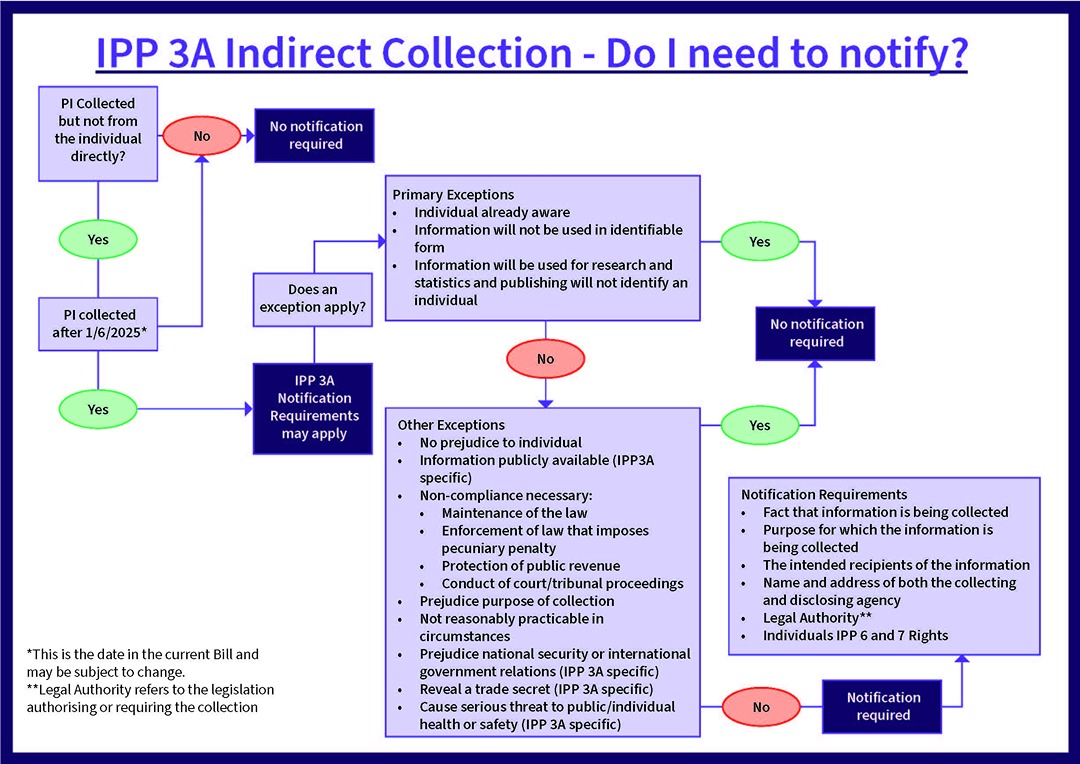
Information privacy principles (or “IPPs”) under the Privacy Act 2020 apply to any public or private agency collecting personal information in New Zealand, including companies and individuals. These principles currently include that information must be collected for a lawful purpose, and protected by reasonable security safeguards. However a new principle, referred to as IPP3A, will create an additional obligation on companies collecting information indirectly i.e. from sources other than the individual concerned.

Direct vs Indirect Collection

Current principles IPP2 and IPP3 require that information must be collected directly from the individual concerned, except in certain specific scenarios. As part of this direct collection, the agency must take steps to ensure that the individual is aware that their information is being collected, its purpose, and its intended recipients.

One of the exceptions to direct collection is where the individual has authorised the collection of the information from another source, for example through external agencies providing credit or background checks, or third-party data brokers selling customer data.  Currently, the Act does not require the individual to be notified of that indirect collection.

New IPP3A

IPP3A is set to come into force in May 2026, introducing a new requirement on agencies to ensure that individuals are aware of the fact that information has been collected, even where that collection happens indirectly.

Under IPP3A the agency must take steps that are reasonable “in the circumstances” to ensure that even when it collects information about an individual indirectly, the individual is aware of:

  • The fact that information has been collected;
  • The purpose for which information was collected;
  • The intended recipients of that information;
  • The details of the agencies that collected the information, and that hold the information;
  • Any particular law authorising the collection of the information; and
  • The individual’s rights of access and correction of the information.

These steps must be taken ideally before the information is collected, or as soon as practicable afterwards.

Exceptions

There are some specific exceptions to this requirement, including where:

  • Compliance is not reasonably practicable in the circumstances;
  • Non-compliance would not prejudice the individual’s interests;
  • Compliance with the requirements would prejudice the purposes of the collection; or
  • Informing the individual concerned would cause a serious threat to public health or safety, or to the health or safety of another individual.

How to prepare

It is critical that you are aware of all information collections undertaken by your business whether directly or indirectly, from sales and marketing through to IT and human resources, and have considered your obligations from a privacy perspective. The Privacy Commission publishes a template collections register, in which you can record the information collections that your business undertakes, and work through the applicable requirements for each. The Commission also publishes a handy flowchart to take you through information collection step-by-step and identify your obligations.

The new information privacy principle comes into effect on 1 May 2026, so you have time to consider what systems you need to introduce or improve to ensure compliance. The Commission intends to publish additional guidance on the new principle and how organisations can best prepare, so watch this space. In the meantime, please talk to your lawyer about whether these changes will impact your business.


Jessica is a Senior Associate in our Commercial Team and can be contacted on 07 958 7436.

I’m a Business Owner…Do I need a Trust?

Owning and running a business is inherently risky.  Even the most diligent businesspeople can come up against unforeseen trials.  Future planning is critical, so you are well equipped long before your business faces challenging times.  Asset protection isn’t designed exclusively for the corporate giants; it’s a prudent and practical thing that every business owner should consider.

What is a Trust?

Simply put, a trust is a legal arrangement involving three groups of people:

  • Settlor(s): the individual(s) who provide assets to the trustees to be held on trust.
  • Trustees: the people who hold the assets for the benefit of the beneficiaries. Trustees administer the assets in accordance with the Trust Deed and the Trusts Act 2019.
  • Beneficiaries: the individual(s) who receive the benefit of the trust assets.

How does a Trust Protect my Assets?

When you transfer your personal assets into a trust, they are no longer yours but belong to the trustees.  As legal ownership has shifted to the trustees, this can protect your assets from business related creditors, insolvency and legal proceedings.  Furthermore, trusts can be used as an effective succession planning tool, giving you the ability to seamlessly pass your wealth on to future generations whilst managing the risk of the likes of relationship property claims.  This makes trusts an invaluable tool for long-term asset protection and estate planning.

Protecting your family home, investments and other personal assets is vital, especially when you dedicate so much time and effort towards developing your business and building your wealth.  Having a trust can help protect not only your lifestyle, but the legacy you’ve worked so hard to create, ensuring that any unforeseen business related challenges don’t threaten your long-term security and retirement plans.

Is a Trust Right for You?

If you are contemplating whether a trust is suitable for you, you’ve already taken an important first step.  The answer really depends on your specific circumstances.  Ask yourself:

  • Do I have valuable business or personal assets to protect?
  • Am I concerned about future liability or personal exposure?
  • Do I want to pass my business to family or beneficiaries?
  • Do I want flexibility in managing income and tax planning?

If you answered “yes” to one or more of these, a trust could be worth exploring.

It is important to note that trusts aren’t a one size fits all solution; they require due care and consideration, alongside strategic future planning that is specifically tailored to your individual circumstances.

Our experienced Asset Planning Team understands the complexities involved with business ownership and asset protection and can evaluate your needs to develop a suitable asset protection strategy.  We can guide you through every step, from establishment to day-to-day management.

Contact us to discuss your asset protection requirements and we will work with you to create a strategy to ensure your assets remain protected, giving you peace of mind for the future.

Long term maintenance plans (LTMPs) and the importance of long-term maintenance funds (LTMFs).

What is a Long-Term Maintenance Plan (LTMP)?

A LTMP is a planned maintenance strategy for bodies corporate.

A LTMP allows current owners and future owners to know what works are required to maintain the building asset, common property and commonly owned assets, as well as when the works are required. This in turn allows owners to be able to budget accordingly for these works without any big surprises.

What types of things are covered in a LTMP?

  • Building washes
  • Lift replacement
  • Roof replacement
  • Repainting of the building
  • Cladding replacement

Should my BC have a LTMP?

Yes, a body corporate is required by legislation to have a LTMP (section 116 Unit Titles Act 2010 (Act)). There is no ability to opt out of this requirement.

However, the requirement for the length of the LTMP varies depending on the size of the body corporate (BC).

A large BC (10 or more principal units) must have a LTMP that covers a period of at least 30 years from the date of the LTMP or the last review of the LTMP.  Unit Title Regulations 2011 section 30A.

A BC that is less than 10 principal units must have a LTMP that covers a period of at least 10 years.

How often should the LTMP be reviewed?

The LTMP must be reviewed every 3 years, however, if the BC becomes aware of any matter than may have a material impact on the LTMP, the LTMP must be reviewed as soon as practicable.

What is a Long-Term Maintenance Fund (LTMF)?

A LTMF is what funds the LTMP.

Does my BC need a LTMF?

Section 117 of the Act dictates that a BC must establish and maintain a LTMF unless the BC, by special resolution (75%), decides not to do so.

Recent changes to the legislation also mean that if the BC has decided not to establish the funds, the BC:

1. Must review the decision annually; and

2. May, by special resolution, decide to establish a fund.

Whether the BC should have a LTMF or not, is going to differ from BC to BC, as each BC has different needs.

For example, if the only common asset of the BC is a shared driveway, then the BC may consider it reasonable not to have a LTMF, and owners can pay for the maintenance of this driveway when it is needed.

However, for a 100-unit apartment complex with a swimming pool, gym and lifts, it is reasonable to have a LTMF.

Are there restrictions around how the LTMF can be used?

Yes, the BC can only use the LTMF for spending in relation to the LTMP; so, the BC cannot dip into this for other general BC expenditure, or unplanned expenditure. This is why reviewing the LTMP as soon as the BC becomes aware of any necessary maintenance is so important.

How much should be in my BC’s LTMF?

This is not black and white, as this is dependent on the needs of the BC.

It may be beneficial for a BC, when preparing a budget for the LTMF, to engage the assistance of specialists/professionals.

Why should unit title owners have to pay towards a LTMF?

Not having a LTMP/LTMF can impact the following:

  • Re-saleability: purchasers see value in a well-maintained building, and a BC which has money in the kitty to pay for the necessary maintenance. Purchaser’s may be dissuaded from purchasing a unit title property where they know they will have to pay large levies for work that needs to be done in the near future, or they simply may not be able to finance this.
  • Equitability: ensures that owners are paying for their use of the commonly owned property/commonly owned assets, rather than future owners who have not benefitted from the use of these and must pay for it down the line.
  • Financial stability: allows owners to adequately budget for maintenance that needs to be done.

If you have any questions about LTMP or LTMF’s, please get in touch with our friendly property team.

Navigating the changing landscape: key proposals for Te Ture Whenua Māori Act 1993 and Resource Management Act 1991 legislation

The Government has recently announced proposals to amend Te Ture Whenua Māori Act 1993 (TTWMA) and the Resource Management Act 1991 (RMA).  These proposals are aimed at narrowing the scope of the current system, its effects and controls, with the guiding principle to centre legislation around the enjoyment of property rights.  For TTWMA, a key reason for the proposed changes is to improve the efficiencies of the Māori Land Court and assist with a vast number of applications before the Court.


Resource Management Reforms

The Government intends to replace the RMA with two new pieces of legislation – The Planning Act – focuses on regulating use, development and enjoyment of land; and The Natural Environment Act – focuses on use, protection and enhancement of the natural environment.

The new legislation could remove the use of the current section 8 provision for decision-makers to take into account the principles of the Treaty/Te Tiriti with more of a focus shifting toward around recognising and upholding Treaty Settlements.  This is a significant change which could have extensive impact and effects on Māori and Te Ao Māori within the new framework.  While the legislation is yet to be introduced, now is a good time for relationship building between local council, iwi and hapū.  This can be as simple as having hui to open lines of communication and trust between parties.  You may share your concerns about the legislation and begin the kōrero of how this may practically affect your respective interests within your rohe.


Whenua Māori Reforms

The Government is also undertaking public consultation on proposed changes to TTWMA, to promote the development and retention of whenua Māori.  Feedback must be provided to Te Puni Kōkiri by Friday, 23 May 2025.  Further details and particulars around the proposed changes can be found here: Discussion document

The key proposed changes include:

  • Enabling a central register of whenua Māori owners/trustees
  • Enabling the Registrar of the Court to be able to file for a review of trust
  • Widening the scope of the Court in relation to appointed agents
  • Widening the powers of the Māori Land Court regarding amalgamated land
  • Enabling the Court to vest a freehold interest in General land in the beneficiary of a will or administrator of an estate
  • Extending the period for which a long-term lease can be granted without Court approval from 52 years to 99 years

Most of the proposed changes may assist in this way, particular thought should be given to proposed long-term lease arrangements and matters of appointed agents for whenua Māori where no governance structure is in place.  If you would like to hear more about the proposed changes, an online information session will be held on Thursday, 15 May.  The link for the May session is here: 15 May Online Session


While Te Puni Kōkiri have proposed a number of changes, they are also open to any feedback on how TTWMA can be improved.  Feedback on any of the proposed changes to TTWMA can be sent to either via email to ttwma@tpk.govt.nz or by physical copy to Te Puni Kōkiri National Office, 143 Lambton Quay, Wellington Central, Wellington, 6011.


Our whenua Māori and Taiao teams at McCaw Lewis are available to assist with a wide range of services within these spaces and are available for answering any pātai that you may have around these new changes and how they may affect you.

Tazmyn Prendiville-Stowers and Hakaraia Richards-Coxhead are in our Whenua and Taiao teams and can be contacted on:

Tazmyn: 07 958 7467

Hakaraia: 07 901 0712

Is Copyright Relationship Property?

On 6 March 2025, the Supreme Court in Alalääkkölä v Palmer [2025] NZSC 9 confirmed that copyright is relationship property, and effectively up for grabs.  The decision is the latest chapter in a dispute dating back to 2017 between Sirpa Alalääkkölä and Paul Palmer.

Alalääkkölä v Palmer has been widely discussed as having a potential impact on artists, creatives and intellectual property.  But as the dust settles, how might this actually affect you? We take you through the decision, and some practical matters to be aware of.

Background

Sirpa Alalääkkölä (Ms Alalääkkölä) and Paul Palmer (Mr Palmer) separated in 2017, after 20 years of marriage.  Ms Alalääkkölä, an accomplished artist, provided the main source of income for the family.  On separation, Ms Alalääkkölä agreed Mr Palmer could keep several artworks as relationship property.  Mr Palmer then sought to copyright, reproduce, and sell copies of those paintings, which Ms Alalääkkölä objected to, setting the scene for a multi-year dispute centred around copyright.  This novel legal dispute covered previously unexplored territory between copyright and relationship property.

Legal Issues

The issues for the Supreme Court to decide were:

  • Is copyright “property”, for the purposes of the Property (Relationships) Act 1976 (PRA)?
  • If so, is copyright relationship property, or separate property, under the PRA?
  • How should the financial value derived from copyright be allocated under the PRA?

Implications

Who Owns Copyright in a Relationship?

  • The Copyright Act 1994 gives the author of a work a variety of rights, such as the right to reproduce, sell, and distribute copies. It also includes the ability to waive those rights.
  • The long-standing approach in New Zealand is that copyright is a form of personal property. However, copyright created during a marriage holds an economic value.  That economic value, according to Alalääkkölä v Palmer [2025] NZSC 9, is relationship property.
  • In short, while the owner of the copyright keeps the moral and personal rights of the copyright, the economic value derived from that copyright can be valued for the purposes of the PRA.
  • The Courts will also choose a division which respects the copyright owner’s right to disclose to the public as they please, where it is consistent with a just division of relationship property.

Valuing Copyright

After confirming copyright as relationship property under the PRA, the Court made subsequent directions for the Family Court to deal with valuing Ms Alalääkkölä’s work, under several categories:

  • incomplete, damaged or unsuitable;
  • intended to be kept private;
  • a unique piece;
  • a piece (or pieces) with multiple copies.

The Court also emphasised that a market valuation should reflect whether copyright for specific artwork has been monetised in the past, and whether the artist intends to exploit it in the future.

Conclusion

The distinction between a right to create, and the financial benefits that flow from that right, can be difficult to define.  However, that distinction can clearly become the subject of dispute, as shown by Alalääkkölä v Palmer [2025] NZSC 9.

Our team at McCaw Lewis regularly deal with intricacies in the relationship property space. They can provide you with the right support and assistance, starting from the commencement of discussions, through to complex legal Court proceedings.  If your situation requires legal guidance, please get in touch with us.


Zane Mora is an Associate in our Dispute Resolution Team and can be contacted on 07 958 7431.

Preventing employment relationship problems

Keeping a healthy and productive employment relationship between an employer and employee is an important part of working together for the betterment and benefit of the overall business.  It goes without saying that issues and problems can crop up from time to time, whether intentional or unintentional, the best way to prevent employment relationship problems is to stop issues before they start.

Employment agreements must contain a simple, plan language explanation of how to resolve employment relationship problems and often referred to as dispute resolution.  It should be written clearly so that everyone knows what steps they need to follow if they think or if there is a problem.

Recognising an issue early

An employment issue includes anything that harms or that may harm the employment relationship. There can be many employment relationships, for example between:

  • Employer and employee
  • Employees
  • Manager and employee.

It is important to think through the problem and gather all relevant information.  It is worth spending some time at this stage trying to identify the underlying cause in order to see how the problem might be resolved.  Generally, this would involve collecting the information is the first step in resolving an issue.  It is about being honest as missing out important facts or changing the facts can make the problem worse.

Before taking it up with an employer or employee, it might be a good idea to talk through a problem with another manager or HR department to clarify whether a problem exists and what the issues might be; the cause of a problem might not be obvious.  Always take care to respect the privacy of other and protect confidential information.

Some simple practices that can help make relationships smoother and prevent problems as an employee:

  • Take time to communicate clearly. Poor communication can often cause disputes and misunderstandings.
  • Raise concerns when they first appear can assist resolving them from becoming larger and/or harder to resolve.
  • Making sure you know and understand workplace policies and procedures.
  • Being prepared to engage in regular performance check-ins and stay updated on changes in the workplace.
  • Use the proper channels to report concerns like bullying, discrimination, or harassment.
  • Taking responsibility can help prevent and resolve misunderstandings, confusion or mistakes such as speaking up if you think there’s an error, like an overpayment.

On the other side, here are some simple practices that can help employers build smoother relationships and prevent problems:

  • Encourage employees to raise issues right away to avoid escalation.
  • Ensure workplace rules and procedures are easy to understand and well communicated, especially policies around resolving problems/concerns.
  • Implementing clear systems for setting performance expectations, holding regular check-ins, keeping staff informed, and managing changes or performance issues.
  • Having clear processes for addressing issues like bullying, discrimination, or harassment.
  • Foster shared responsibility and encourage a culture where everyone helps prevent and resolve mistakes, such as reporting errors like overpayment.
  • As long as you follow workplace policies, you can remain flexible and explore different ways to address concerns when considered separately, helping to resolve issues while acting in good faith.


Alternative resolution pathways

Both parties should first attempt to resolve issues between themselves to prevent escalation and maintain a positive working relationship.  If this informal approach does not work, mediation may be considered.  With both parties’ agreement, an independent mediator could help facilitate discussions, identify issues, and propose mutually beneficial solutions.  This service is free and provide by the Ministry of Business, Innovation, and Employment.


If you are needing advice about what dispute resolution process and/or policies you currently have in place or have current issues that you wish to resolve in a proper and fair way, McCaw Lewis has an experienced workplace team who can assist you.

Cree Ratapu is a Senior Solicitor in our Workplace Law Team and can be contacted on 07 808 6069.

Ngā Kerēme Mō Ngā Kura Auraki – (Making Claims For Those in State Schools and State Care)

Are you or do you know anyone who might be entitled to a sensitive claim settlement?

Sensitive claims in New Zealand involve compensation for abuse, neglect, or mistreatment, within government institutions.  These claims address deeply personal trauma and provide justice and redress for the affected individuals.  Our team can assist in working through these things.


Legal Process for Sensitive Claims of Abuse in State Schools

The Ministry of Education’s process for handling sensitive claims of abuse in state schools provides individuals with a structured means to seek redress for past mistreatment or abuse. These claims can include physical, sexual, or psychological abuse that occurred while the claimant attended a state school.  This legal avenue is available for individuals who attended schools before 1989 or schools that are now closed, such as specialist schools and health camps.

The process involves several key steps, beginning with the submission of a claim form, which requires basic information and consent to access relevant records.  The Ministry may offer support services, including counselling, during the processing of the claim.  Once the claim is reviewed, an external assessor will evaluate the information, and if wrongdoing is identified, an apology or financial compensation may be offered.

Individuals who believe criminal conduct was involved can refer their case to the police.  The Ministry’s approach ensures that each claim is handled with sensitivity, providing appropriate accommodations for individuals’ needs, such as language support or legal counsel.

This legal process allows individuals to seek acknowledgment of their experiences while protecting their right to pursue further legal actions if desired.


Rapid Payment Options

The Ministry of Education has recently implemented rapid payment options for individuals who have attended Waimokoia/Mt Wellington Residential School and have a sensitive claim of abuse and people who are terminally ill.  These payments provide a quicker redress process compared to the full claims assessment.

Waimokoia/Mt Wellington Residential School

Claimants who attended this school can opt for a rapid payment which includes a set amount based on the decade they attended the school, reflecting average payments under the full claims assessment process, an apology from the Secretary for Education and a reimbursement for legal costs.

Payments are determined by the decade in which a claimant attended school.  For example, a claimant who attended Waimokoia/Mt Wellington Residential School in the 1960s would receive $5,000, while a claimant who attended in the 1970s would receive $10,000.

Extra payments may be made if there is evidence of specific instances of abuse during certain years.   For example, a claimant who attended between 1960 and 1961 would receive $15,000, which includes the standard $5,000 for the 1960s and an extra $10,000 due to documented staff abuse during that period.


Future of Rapid Payment Options

Currently only claimants who attended Waimokoia/Mt Wellington Residential School are eligible for the rapid payments option however, once research for McKenzie Residential School and Campbell Park School is completed, rapid payments will also be available for claimants who attended these schools.


Terminally Ill Claimants

Individuals who are terminally ill and expected to live less than 12 months can receive a prioritised settlement payment of $10,000, along with an apology and legal fee reimbursement.


Sensitive Claims Through Other Government Agencies

Currently, survivors of historical abuse in State care can make a claim through various government agencies such as:


(a) Ministry of Education

(b) Oranga Tamariki

(c) Ministry of Health

(d) Ministry of Social Development


If you would like assistance with making a claim or further information and advice, please contact Preston Rawiri on 07 957 2352 or preston.rawiri@mccawlewis.co.nz

Contact us

HAMILTON OFFICE

P. 07 838 2079

E. reception@mccawlewis.co.nz

Level 6, 586 Victoria Street
Hamilton 3204
New Zealand

TE KŪITI OFFICE

P. 07 878 8036

E. reception@mccawlewis.co.nz

36 Taupiri Street
Te Kūiti 3910
New Zealand